
Publications

Nonintegral Flux Trapping in Frustrated Josephson Networks of Triplet Superconductors | arXiv: 2604.24734 | arXiv 2026
Frazier, Grayson R; Lelievre, Colton; Li, Yi
This work shows that anisotropic Josephson coupling between spin-triplet superconducting grains can frustrate both condensate phases and relative d-vector orientations, producing emergent geometric phases, spontaneous Josephson currents, and nonintegral flux trapping. The authors identify a three-grain-ring example in which sufficiently strong antisymmetric Josephson coupling drives time-reversal-symmetry breaking, chiral d-vector textures, and spontaneous half-flux-quantum trapping. Its importance is that it establishes the internal spin structure of Cooper pairs as a distinct mechanism for frustration, beyond fixed tunneling phase shifts or orbital pairing symmetry. The work therefore offers a route to engineer frustrated Josephson networks through the interplay of magnetic textures and triplet pairing order, with relevance to polycrystalline and single-crystal superconducting systems.

Spinor pairing order enforced by Berry phase | arXiv: 2409.09579 | Physical Review Research 2026
Li, Yi; Frazier, Grayson R.
This paper introduces spinor pairing orders with half-integer pair monopole charge, arising when Cooper pairs form between Fermi surfaces whose Chern numbers differ in parity. Unlike conventional pairing symmetries described by spherical harmonics, these topological orders are governed by pair Berry phases and monopole harmonics, which enforce gap nodes and constrain their total vorticity. Using cubic-lattice tight-binding models, the authors demonstrate a j=1/2 spinor superconductor with monopole charges ±1/2, a single chiral BdG gap node, and zero-energy Majorana surface states. The work expands the framework of topological many-particle order beyond conventional superconductivity and predicts a fractionalized Mermin–Ho relation for spatially inhomogeneous pairing, with extensions to density waves and excitons.

Anisotropic Josephson Coupling of d Vectors in Triplet Superconductors Arising from Frustrated Spin Textures | arXiv: 2506.15661 | Physical Review Letters 2026
Frazier, Grayson R.; Zhang, Junyi; Li, Yi
This work shows that frustrated, noncollinear magnetic textures can generate anisotropic Josephson couplings between spin-triplet superconducting d vectors, analogous to Dzyaloshinskii–Moriya and Γ-type magnetic interactions. These couplings promote spatially varying triplet-pairing textures by competing with superfluid stiffness, providing a mechanism for “pliable” superconducting order. The study further predicts anomalous zero-field vortices for nonunitary pairing and a Josephson diode effect whose efficiency is proportional to the underlying spin chirality. Its key importance is to establish a theoretical link between frustrated magnetism and unconventional triplet superconductivity, relevant to systems including Mn3Ge and 4Hb-TaS 2

Spatially inhomogeneous triplet pairing order and Josephson diode effect induced by frustrated spin textures | arXiv: 2510.25756 | Physical Review B 2026
Frazier, Grayson R.; Li, Yi
This paper shows that frustrated local spin textures can induce anisotropic Josephson couplings between spin-triplet superconducting d vectors, stabilizing spatially inhomogeneous pairing orders. These couplings arise from spin-dependent tunneling generated by coupling itinerant electrons to frustrated local exchange fields, rather than from spin-orbit coupling. Its central importance is the identification of a pairing-order “pliability” that competes with superfluid stiffness and can favor nonuniform triplet superconductivity. The work further predicts a Josephson diode effect caused by either spin chirality in the barrier or antisymmetric coupling between noncollinear d vectors, requiring broken inversion and time-reversal symmetries.

Type I and type II superconductivity in a quasi-2D Dirac metal | arXiv: 2307.01976 | Materials Advances 2025
Lygouras, Chris J.; Zhang, Junyi; Gautreau, Jonah; Pula, Mathew; Sharma, Sudarshan; Gao, Shiyuan; Berry, Tanya; Halloran, Thomas; Orban, Peter; Grissonnanche, Gael; Chamorro, Juan R.; Mikuri, Taketora; Bhoi, Dilip K.; Siegler, Maxime A.; Livi, Kenneth J.T.; Uwatoko, Yoshiya; Nakatsuji, Satoru; Ramshaw, B. J.; Li, Yi; Luke, Graeme M.; Broholm, Collin L.; McQueen, Tyrel M.
This work establishes LaCuSb₂ as a quasi-2D Dirac metal with highly anisotropic, dirty-limit weak-coupling multiband superconductivity. Magnetization, muon spin relaxation, and density-functional-theory results identify type-II superconductivity for magnetic fields along the a-axis and type-I behavior for fields along the c-axis. The study further finds that chemical and hydrostatic pressure strongly suppress the superconducting transition, while specific-heat and high-pressure susceptibility features support multigap superconductivity in this multiband metal. Its key impact is to highlight how Dirac nodal-line Fermi surfaces can govern strongly anisotropic superconducting behavior.

Spontaneous π flux trapping in granular rings of unconventional superconductors | arXiv: 2509.24581 | arXiv 2025
Zhang, Junyi; Li, Yi
This work develops a symmetry-based theory of Josephson coupling in unconventional superconductors, including the effects of interface-orientation disorder, to explain spontaneous half-flux trapping in granular superconducting rings. Its central result is a no-go theorem: single-band chiral superconductors cannot spontaneously trap flux regardless of grain or interface orientation, excluding chiral p-wave pairing as an explanation for the half-quantum-flux observations in β-Bi₂Pd. The authors instead propose that β-Bi₂Pd realizes an effective time-reversal-invariant triplet helical equal-spin pairing state induced by spin-orbit coupling associated with local inversion-symmetry breaking. Such helical superconductors can support robust spontaneous π-flux trapping even under strong interface disorder, reconciling phase-sensitive Little–Parks observations with the reported nodeless gap and absence of time-reversal-symmetry breaking.

Designing phase sensitive probes of monopole superconducting order | arXiv: 2407.18701 | Physical Review Research 2024
Frazier, Grayson R.; Zhang, Junjia; Zhang, Junyi; Sun, Xinyu; Li, Yi
This work proposes phase-sensitive Josephson experiments to identify monopole superconducting order, an exotic three-dimensional topological pairing state arising when Cooper pairs form between Fermi surfaces with different Chern numbers. Unlike conventional s-, p-, or d-wave orders, monopole pairing is characterized by monopole harmonics and cannot be globally defined on the full Fermi surface because of a topological obstruction in its U(1) phase. The central idea is to measure the discrepancy between the conserved global angular momentum, which includes pair Berry-flux contributions, and the locally defined angular momentum of the pairing order. Through analytic and numerical studies of Josephson coupling, the paper shows that this approach can reveal pair monopole charges with magnitudes 1, 2, and 3. The work is important because it provides a practical route to distinguish monopole pairing from conventional spherical-harmonic superconducting symmetries and to access its distinctive topological properties experimentally.

Monopole Superconductivity in Magnetically Doped Cd3As2 | arXiv: 2204.04249 | arXiv 2022
Bobrow, Eric; Li, Yi
This paper predicts monopole superconductivity in magnetically doped Dirac semimetal Cd3As2, where parity-related Fermi pockets carry opposite Chern numbers. The work is important because such inter-Fermi-surface pairing has a nontrivial pair Berry phase, producing monopole-harmonic gap functions that cannot be globally defined on a Fermi surface and therefore enforce topologically protected nodes. A key result is that pairing between Chern-number ±1 pockets yields linear Bogoliubov–de Gennes Weyl nodes, whereas pairing between ±2 pockets can yield either quadratic nodes on the four-fold rotation axis or linear nodes away from it, depending on the pairing form. By showing that chemical potential can select distinct Chern-number pockets and quasiparticle structures, the study identifies magnetically doped Cd3As2 as a platform for realizing and tuning unconventional topological superconductivity.

Integer quantum Hall effect and enhanced g factor in quantum-confined Cd3As2 films | arXiv: 2207.09018 | Physical Review B 2022
Xiao, Run; Zhang, Junyi; Chamorro, Juan; Kim, Jinwoong; McQueen, Tyrel M.; Vanderbilt, David; Kayyalha, Morteza; Li, Yi; Samarth, Nitin
This work investigates integer quantum Hall states in strongly quantum-confined Cd₃As₂ films (10–15 nm), where confinement modifies both bulk subbands and surface-derived states. The authors observe ν = 1 and even filling-factor states (ν = 2, 4, 6) across the films, while a ν = 3 state emerges in the thinnest films, evidencing lifted spin degeneracy at 9 T. Tight-binding calculations attribute this behavior to confinement-enhanced Zeeman splitting, with additional corrections from nearby subbands. The study is important because it clarifies how thickness controls the Landau-level spectrum and g factor in Cd₃As₂, overturning expectations of a monotonically decreasing g factor with decreasing thickness and advancing understanding of quantum Hall physics in confined topological semimetal films.

Anomalous Residual Surface Conductivity in a Superconductor with Strong Spin-Orbit Coupling | arXiv: 2112.10840 | arXiv 2021
Chamorro, J R; Chauhan, P; Sun, C; Varnava, N; Winiarski, M J; Ng, N; Vivanco, H K; Pressley, L A; Pasco, C M; Vanderbilt, D; Li, Yi; Armitage, N P; McQueen, T M
This paper reports anomalous microwave surface dissipation in the centrosymmetric superconductor PdPb₂ below its bulk transition temperature of 3.0 K, despite bulk measurements indicating a fully gapped, conventional superconducting state. The surface resistance remains finite at low temperature, and the inferred dissipative conductivity exceeds its normal-state value, behavior inconsistent with conventional superconducting electrodynamics. The authors rule out extrinsic origins and propose that PdPb₂ is a candidate topological superconductor, in which metallic surface states—potentially a dissipative Majorana fluid—coexist with a fully gapped superconducting bulk. This work is important because topological superconductors can host Majorana fermions and are proposed platforms for topological quantum computing.

Ferromagnetic percolation transition in a multiorbital flat band assisted by Hund's coupling | arXiv: 2011.10554 | Physical Review B 2021
Bobrow, Eric; Zhang, Junjia; Li, Yi
This paper establishes an exact route to ferromagnetism in a multiorbital flat-band system by combining Hund’s coupling with flat-band localization. It introduces a two-layer model of px, py-orbital honeycomb and f-orbital triangular lattices whose flat band supports localized states and, at suitable chemical-potential difference and at least half filling, admits a correlated percolation representation. Its key importance is that Hund’s coupling restores a rigorous percolation description even when three localized states overlap at a site, a situation that violates standard Mielke–Tasaki conditions in multiorbital systems. The resulting ground states are described by maximum-spin localized-state clusters, and Monte Carlo simulations show a paramagnetic-to-ferromagnetic transition as the band approaches half filling.

Berry Phase Enforced Spinor Pairing | arXiv: 2001.05984 | arXiv 2020
Li, Yi
This paper proposes spinor pairing, a new class of three-dimensional topological superconductivity in which Cooper pairs between Fermi surfaces whose Chern numbers differ by an odd integer acquire a half-odd-integer monopole charge. The resulting gap functions are monopole harmonics with fractionalized, spinor partial-wave symmetry rather than conventional integer spherical harmonics. Its central importance is that the pair Berry phase creates a topological obstruction that prevents a globally regular gap function on the Fermi surface, enforcing nodal structures independently of microscopic pairing mechanisms. In particular, spinor gap functions can host an odd number of nodes on a closed Fermi surface, a feature stated to distinguish them from previously known pairing symmetries. The work expands the classification of superconducting order beyond ordinary spherical-harmonic and lattice pairing channels, and predicts distinctive consequences including nontrivial Bogoliubov nodal excitations and a fractionalized Mermin–Ho relation for spatially inhomogeneous spinor order parameters.

Monopole charge density wave states in Weyl semimetals | arXiv: 1810.08715 | Physical Review Research 2020
Bobrow, Eric; Sun, Canon; Li, Yi
This work shows that charge-density-wave (CDW) order formed between nested electronlike and holelike Fermi surfaces with different Chern numbers inherits nontrivial Berry-phase topology. The resulting CDW gap function cannot be globally defined in momentum space, must become nodal, and has a total vorticity fixed by the Chern-number difference of the nested Fermi surfaces. These gap nodes produce new Weyl nodes in the low-energy quasiparticle spectrum, with chiralities determined by the original band-structure Weyl points. The work is important because it extends monopole-harmonic and Berry-phase concepts from superconducting particle-particle order to particle-hole CDW order.

Z2 Topologically Obstructed Superconducting Order | arXiv: 2009.07263 | arXiv 2020
Sun, Canon; Li, Yi
This paper proposes a new class of three-dimensional, time-reversal-invariant topological superconductors in which the pairing order itself carries a non-Abelian Z2 topological obstruction. Unlike conventional s-, p-, and d-wave pairing, the order cannot be globally defined on the Fermi surface without singularities, producing nodal gap functions and a time-reversal-invariant analogue of monopole harmonic pairing. The authors show that inter-Fermi-surface pairing between time-reversal- and mirror-related Z2-nontrivial Fermi surfaces inherits this obstruction in the weak-coupling regime. Its importance is that it extends topological superconductivity beyond classifications focused solely on Bogoliubov–de Gennes quasiparticle states, identifying topology directly in the superconducting order parameter. Using a doped Z2 Dirac-semimetal tight-binding model with inter-orbital pairing, the work predicts bulk gap nodes and protected time-reversal-paired surface states forming zero-energy Majorana arcs between projected bulk nodes.

Robust Flat Bands with Tunable Energies in Honeycomb Superlattices | arXiv: 2012.07806 | arXiv 2020
Qi, Zihao; Bobrow, Eric; Li, Yi
This paper shows that honeycomb superlattices with decorated edges host flat bands that remain robust under symmetry-preserving longer-range hopping perturbations, addressing the common tendency of realistic longer-range hoppings to disperse flat bands. The authors analytically derive tunable flat-band energies and construct localized plaquette and loop eigenstates from standing waves, whose destructive interference prevents leakage outside the localized structures.The work is important because robust, tunable flat bands provide a platform for strong-correlation and topological physics, while their high density of states may enhance superconductivity and other correlation effects. It also offers principles for understanding and predicting flat bands in realistic materials despite longer-range hopping processes.

Counterrotating magnetic order in the honeycomb layers of NaNi2BiO6−δ | arXiv: 1807.02528 | Physical Review B 2019
Scheie, A.; Ross, K.; Stavropoulos, P. Peter; Seibel, E.; Rodriguez-Rivera, J. A.; Tang, J. A.; Li, Yi; Kee, Hae-Young; Cava, R. J.; Broholm, C.
This paper identifies NaNi₂BiO₆₋δ as a honeycomb antiferromagnet realizing bond-dependent Kitaev–Γ–Heisenberg exchange with high-spin Ni³⁺ moments, expanding Kitaev-material research beyond the established 4d and 5d systems. Magnetic ordering occurs in two stages: c-axis moments below 6.3 K and an in-plane counterrotating state below 4.8 K, with propagation vector q = (1/3, 1/3, 0.15(1)). Density-functional theory and ESR support high-spin Ni³⁺ magnetism near a high-to-low-spin transition, while the observed ordering, correlations, entropy, and exchange pathways are consistent with dominant bond-dependent Kitaev interactions. The work is important because it demonstrates that 3d Ni ions can host anisotropic bond-dependent exchange, opening a broader materials platform for pursuing Kitaev spin liquids and high-spin Kitaev physics.
Vortices in a Monopole Superconducting Weyl Semi-metal | arXiv: 1909.04179 | arXiv 2019
Sun, Canon; Lee, Shu-Ping; Li, Yi
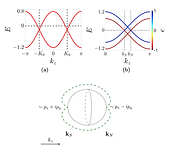
This paper investigates Majorana zero-energy vortex bound states in monopole superconductors realized in time-reversal-breaking Weyl semimetals with proximity-induced superconductivity. Monopole superconductivity is distinguished by a gap function with monopole-harmonic symmetry and nonzero momentum-space vorticity, which enforces topologically protected gap nodes. The authors show analytically and numerically that vortex zero modes acquire nontrivial real-space phase winding inherited from the momentum-space order-parameter winding. By mapping the vortex problem to a (1+1)-dimensional Dirac Hamiltonian with a mass domain wall, they establish that these modes are topologically protected by an index theorem. The work therefore extends the understanding of vortex-bound Majorana physics beyond fully gapped conventional topological superconductors to nodal superconducting phases with nontrivial Cooper-pair Berry-phase structure.

Magnetic Field Enhanced Superconductivity in Epitaxial Thin Film WTe2 | arXiv: NA | Scientific Reports 2018
Asaba, Tomoya; Wang, Yongjie; Li, Gang; Xiang, Ziji; Tinsman, Colin; Chen, Lu; Zhou, Shangnan; Zhao, Songrui; Laleyan, David; Li, Yi; Mi, Zetian; Li, Lu
This study reports epitaxial MBE-grown WTe₂ thin films exhibiting magnetic-field-enhanced superconductivity, a non-monotonic temperature dependence of the in-plane upper critical field Hc2, and Hc2 values exceeding the Pauli limit by more than tenfold. These observations are important because magnetic fields conventionally suppress superconductivity, whereas the reported behavior provides direct evidence for unconventional pairing physics. The results support a possible non-centrosymmetric Ising-superconductivity mechanism associated with inversion-symmetry breaking and strong spin–orbit coupling, while finite-momentum pairing is also proposed as a possible explanation. By establishing WTe₂ thin films as a platform with field-enhanced superconductivity, the work expands the search for unconventional superconducting states beyond previously studied layered dichalcogenides and motivates further experiments on pairing symmetry and electronic structure.

Stability of the Nagaoka-type ferromagnetic state in a t2g orbital system on a cubic lattice | arXiv: 1801.02583 | Physical Review B 2018
Bobrow, Eric; Li, Yi
This paper extends Nagaoka-type itinerant ferromagnetism to multihole, orbital-active t2g systems on a cubic lattice, addressing a setting relevant to realistic multiorbital materials where Hund’s coupling is important. In the U→∞ limit, it shows that fully spin-polarized generalized Nagaoka states become degenerate with the ground state in the thermodynamic limit when holes are sufficiently dilute: for quasi-2D t2g bands, holes per orbital plane scale slower than L1/2; for 3D bands, the hole number scales slower than L5/6. These results hold for arbitrary ferromagnetic Hund’s coupling J>0 and interorbital repulsion V≥0. Its key impact is to provide nonperturbative stability bounds for itinerant ferromagnetism in a multiorbital, higher-dimensional setting and to show that increasing Hund’s coupling shrinks the region unstable to a single-spin flip.

Exact results on itinerant ferromagnetism and the 15-puzzle problem | arXiv: 1804.02347 | Physical Review B 2018
Bobrow, Eric; Stubis, Keaton; Li, Yi
This paper establishes exact connectivity conditions for Nagaoka ferromagnetism by relating the Hubbard-model single-hole problem to the generalized 15-puzzle problem on graphs. It extends Nagaoka’s theorem to all nonseparable graphs except single polygons with more than four vertices. The key impact is that it proves fully spin-polarized ground states for the infinite-repulsion, single-hole Hubbard model on the two-dimensional honeycomb and three-dimensional diamond lattices, whose larger loops had previously left applicability of Nagaoka’s theorem unresolved. The work also formulates connectivity conditions for multicomponent fermions and generalizes the theorem to SU(N)-symmetric systems on nonseparable graphs.

Topological Nodal Cooper Pairing in Doped Weyl Metals | arXiv: 1510.0173 | Physical Review Letters 2018
Li, Yi; Haldane, F. D. M.
This paper generalizes Berry-phase concepts from single-electron bands to Cooper pairs formed between Fermi surfaces with opposite Chern numbers. It shows that the inherited pairing Berry phase produces a monopole structure, enforcing momentum-space vortices and topologically protected gap nodes whose total vorticity is fixed by the pair monopole charge. The work is important because it identifies a topology-driven form of superconductivity in doped Weyl metals and other systems with topologically nontrivial Fermi surfaces. It predicts that these nodes behave as Weyl–Majorana points and links Weyl-band surface modes to Majorana modes within the pairing gap. For approximately spherical Fermi surfaces, the paper classifies pairing using monopole harmonics rather than ordinary spherical harmonics; topology converts all projected partial-wave pairing channels into monopole channels independent of the microscopic pairing mechanism.

Three-dimensional quaternionic condensations, Hopf invariants, and skyrmion lattices with synthetic spin-orbit coupling | arXiv: 1205.2162 | Physical Review A 2016
Li, Yi; Zhou, Xiangfa; Wu, Congjun
This paper investigates two-component Bose condensates with three-dimensional Weyl-type spin-orbit coupling in a harmonic trap, identifying condensate wave functions with topologically nontrivial three-dimensional skyrmion configurations and spin textures carrying nonzero Hopf invariants. Its central conceptual contribution is the use of a quaternionic representation: quaternionic phases span S3, while associated spin orientations lie on the S2 Bloch sphere through the first Hopf map. The work is important because spin-orbit-coupled bosons can evade the positive-definite constraint of conventional Bose-condensate ground states and can spontaneously break time-reversal symmetry. It predicts that weak coupling yields concentric quaternionic and spin textures, intermediate coupling produces symmetry-breaking multicentered skyrmion patterns, and strong coupling supports three-dimensional skyrmion lattices when interactions are below the Landau-level-mixing energy scale. Thus, the study establishes a route to realizing and characterizing three-dimensional topological condensates using quaternionic topology and Hopf-linked spin structures.

Topological Septet Pairing with Spin-3/2 Fermions: High-Partial-Wave Channel Counterpart of the He3-B Phase | arXiv: 1507.02768 | Physical Review Letters 2016
Yang, Wang; Li, Yi; Wu, Congjun
This paper generalizes the isotropic, topological 3He-B pairing state to multicomponent fermions across arbitrary partial-wave channels with L≥1. It shows that four-component spin-3/2 systems can host fully gapped, rotationally invariant f-wave septet, p-wave triplet, and d-wave quintet pairings. The work establishes that odd-parity p- and f-wave states are topologically nontrivial, whereas even-parity pairings are topologically trivial. Its key impact is the prediction of large topological indices—maximal value N2 for p-wave pairing—and surface Andreev-Majorana spectra containing multiple Dirac cones of orders from 1 to 2N−1. These results broaden the landscape of three-dimensional topological superconductivity and are relevant to multiorbital solids and large-spin ultracold fermion systems.

Majorana Positivity and the Fermion Sign Problem of Quantum Monte Carlo Simulations | arXiv: 1601.01994 | Physical Review Letters 2016
Wei, Z. C.; Wu, Congjun; Li, Yi; Zhang, Shiwei; Xiang, T.
This paper addresses the fermion sign problem, a major limitation of quantum Monte Carlo simulations for interacting fermion systems. It proves two sufficient sign-problem-free conditions—Majorana reflection positivity and Majorana Kramers positivity—within auxiliary-field determinantal QMC. Its central importance is to provide a unified framework encompassing nearly all previously known sign-problem-free interacting lattice-fermion models. The work also identifies new accessible classes, including repulsively interacting lattice models without particle-hole symmetry and interacting topological insulators with spin-flip terms. These results expand the range of strongly correlated fermion and topological systems that can be studied reliably by scalable QMC methods.

Sign-Problem-Free Quantum Monte Carlo Study on Thermodynamic Properties and Magnetic Phase Transitions in Orbital-Active Itinerant Ferromagnets | arXiv: 1411.0340 | Physical Review X 2015
Xu, Shenglong; Li, Yi; Wu, Congjun
This paper develops sign-problem-free quantum Monte Carlo simulations for a two-dimensional multiorbital Hubbard model to nonperturbatively investigate itinerant ferromagnetism, a strongly correlated problem lacking a controlled weak-coupling description. Its central importance is demonstrating that Hund’s coupling together with electron itinerancy can establish ferromagnetic coherence even without preexisting local moments. The work finds incoherent Curie-Weiss-like spin behavior persisting to temperatures where charge degrees of freedom are already coherent, exponential growth of SU(2) spin susceptibility at low temperature in two dimensions, and long-range ferromagnetism when symmetry is reduced to the Ising class. These results provide a nonperturbative benchmark for understanding and searching for ferromagnetism in correlated transition-metal oxide layers and p-orbital ultracold-atom optical lattices.

Time-reversal invariant SU(2) Hofstadter problem in three-dimensional lattices | arXiv: 1410.6189 | Physical Review B 2015
Li, Yi
This paper constructs a time-reversal-invariant three-dimensional SU(2) Hofstadter model as a lattice realization of 3D Landau levels, extending the conventional 2D Hofstadter problem to a non-Abelian gauge setting. Its central importance is that the lattice model restores full 3D translation symmetry, enabling a quantitative determination of the nontrivial Z2 band topology that was not directly available for continuum 3D Landau-level Hamiltonians. By reducing each in-plane momentum sector to a generalized one-dimensional SU(2) Harper equation, the work connects bulk topology to spatially separated helical boundary states and helical boundary Fermi surfaces. It also investigates topological transitions between weak and strong three-dimensional topological-insulator phases, establishing a framework for analyzing non-Abelian Hofstadter physics and 3D topological band structures.

Exact results for itinerant ferromagnetism in a t2g-orbital system on cubic and square lattices | arXiv: 1501.00536 | Physical Review B 2015
Li, Yi
This paper establishes exact ground-state ferromagnetism results for a strong-coupling multiorbital Hubbard model with t2g orbitals on cubic and square lattices. It generalizes Nagaoka ferromagnetism to systems with three planar orbitals—dxy, dyz, and dzx—coupled by on-site Hund’s interaction. Its central result is that, when intraorbital repulsion is infinite and each relevant orbital layer contains exactly one hole, the three-dimensional cubic system has a fully spin-polarized ferromagnetic ground state that is unique up to trivial spin degeneracy. A corresponding result persists in a reduced two-dimensional system, where the quasi-one-dimensional dyz and dzx bands may have general fillings while the dxy band has either one hole or is full. The work is important because exact theorems provide essential benchmarks for the highly nonperturbative problem of itinerant ferromagnetism. It identifies a multiorbital, Hund-coupled route to robust itinerant ferromagnetism beyond the single-hole setting of conventional Nagaoka physics, with relevance to t2g-active oxide materials such as SrRuO3 and LaAlO3/SrTiO3 interfaces.

Competing Orders in the 2D Half-Filled SU(2N) Hubbard Model through the Pinning-Field Quantum Monte Carlo Simulations | arXiv: 1305.3571 | Physical Review Letters 2014
Wang, Da; Li, Yi; Cai, Zi; Zhou, Zhichao; Wang, Yu; Wu, Congjun
This paper provides a nonperturbative quantum Monte Carlo study of ground-state magnetism in the half-filled two-dimensional SU(2N) Hubbard model, motivated by high-symmetry ultracold-atom systems such as the observed SU(6) Mott insulator of 173Yb. It addresses an important unresolved question: how charge fluctuations and spin correlations determine Néel versus dimer order across weak-, intermediate-, and strong-coupling regimes.Using local pinning fields, which are sensitive to weak long-range order, the authors find long-range Néel order for SU(4) and SU(6) at weak and intermediate interaction strengths. Unlike SU(2), the Néel moments in SU(4) and SU(6) first increase and then decrease with increasing interaction strength. Most significantly, SU(6) undergoes a transition from Néel order to columnar dimerization at strong coupling, attributed to competition between weak-coupling Fermi-surface nesting and strong-coupling local-moment physics.

Exact Results for Itinerant Ferromagnetism in Multiorbital Systems on Square and Cubic Lattices | arXiv: 1310.4391 | Physical Review Letters 2014
Li, Yi; Lieb, Elliott H.; Wu, Congjun
This paper establishes an exact theorem for itinerant ferromagnetism in multiorbital Hubbard models on two-dimensional square and three-dimensional cubic lattices. In the infinite intraorbital-repulsion limit, with positive interorbital Hund’s-rule coupling, the fully spin-polarized states are proven to be the unique ground states up to trivial spin degeneracy over a broad range of filling factors. Its importance lies in providing a rigorous strong-correlation mechanism for ferromagnetism beyond the highly restricted one-hole setting of Nagaoka’s theorem and beyond flatband mechanisms that suppress kinetic-energy differences. The model consists of perpendicular quasi-one-dimensional orbital chains coupled through on-site multiorbital Hubbard interactions, and the result remains robust even without translation invariance or uniform hopping magnitudes. The work may impact studies of p-orbital ultracold-atom optical lattices and 3d-orbital transition-metal-oxide systems, including the LaAlO3/SrTiO3 interface.

Unconventional symmetries of Fermi liquid and Cooper pairing properties with electric and magnetic dipolar fermions | arXiv: 1501.0054 | Journal of Physics: Condensed Matter 2014
Li, Yi; Wu, Congjun
This topical review surveys theoretical advances in Fermi-liquid behavior and Cooper pairing for ultracold electric and magnetic dipolar fermions, a rapidly developing experimental platform for novel many-body physics. Its importance lies in showing that dipolar interactions generate unconventional symmetry structures: aligned electric dipoles produce explicit anisotropy that modifies spectra, susceptibilities, and collective modes, while also enabling spin-triplet pairing and possible time-reversal-symmetry-breaking superfluidity through singlet–triplet competition. For magnetic dipoles, the review highlights intrinsic spin–orbit-coupled interactions that can yield topologically nontrivial collective spin textures and a distinctive J=1 p-wave triplet pairing state, unlike the familiar
3He-A and 3He-B phases.

Honeycomb lattice with multiorbital structure: Topological and quantum anomalous Hall insulators with large gaps | arXiv: 1403.0563 | Physical Review B 2014
Zhang, Gu-Feng; Li, Yi; Wu, Congjun
This paper develops a minimal four-band model for honeycomb lattices with active px/py orbitals, demonstrating that atomic spin–orbit coupling can directly open large topological gaps, unlike in graphene or conventional band-inversion topological insulators. The predicted gap can reach approximately 0.3 eV, potentially exceeding room-temperature energy scales, making these systems promising for robust topological devices. The work identifies how spin–orbit coupling, sublattice asymmetry, and Néel exchange fields drive topological phase transitions and shows that a quantum anomalous Hall phase emerges when the relevant gap parameters satisfy a triangle inequality. Its key impact is to establish px/py-orbital honeycomb materials and optical lattices as a platform for large-gap quantum spin Hall and quantum anomalous Hall states, with relevance to several semiconductor material classes and ultracold-atom realizations.

Spontaneous breaking of time-reversal symmetry in the orbital channel for the boundary Majorana flat bands | arXiv: 1304.4268 | New Journal of Physics 2013
Li, Yi; Wang, Da; Wu, Congjun
This paper shows that boundary Majorana flat bands in single-component p-wave weak topological superconductors/superfluids are intrinsically unstable to spatial variations of the Cooper-pairing phase because their surface density of states diverges. These phase variations couple and energetically bond the zero-energy Majorana modes, producing staggered orbital-current loops near topologically nontrivial boundaries and spontaneously breaking time-reversal symmetry in the orbital channel. The resulting effect splits the Majorana zero-bias peaks and is robust, offering an experimentally relevant signature in both condensed-matter and ultracold-atom systems.

Topological Insulators with SU(2) Landau Levels | arXiv: 1208.1562 | Physical Review Letters 2013
Li, Yi; Zhang, Shou-Cheng; Wu, Congjun
This work constructs continuum models of three- and four-dimensional topological insulators using spin-½ fermions coupled to an SU(2) background gauge field, equivalently a spatially dependent spin-orbit coupling. The models realize higher-dimensional Landau levels with exactly flat spectra in a Landau-like gauge, producing spatially separated helical Dirac modes in 3D and chiral Weyl modes in 4D. Its importance lies in providing analytically tractable continuum topological-insulator Hamiltonians with stable gapless boundary states, independent of conventional band-inversion mechanisms. In four dimensions, the construction further exhibits a quantized 4D quantum Hall effect associated with a spatially separated chiral anomaly. These exact flat-band models offer a useful platform for studying higher-dimensional and potentially fractional topological phases.

Unconventional states of bosons with the synthetic spin–orbit coupling | arXiv: 1301.5403 | Journal of Physics B: Atomic, Molecular and Optical Physics 2013
Zhou, Xiangfa; Li, Yi; Cai, Zi; Wu, Congjun
This review surveys unconventional Bose–Einstein condensates generated by synthetic spin–orbit coupling, principally 2D Rashba and 3D Weyl couplings. Such coupling produces complex-valued condensate wavefunctions beyond the conventional bosonic no-node theorem and enables phenomena absent in ordinary condensates. Its importance lies in identifying ultracold bosonic gases as highly controllable platforms for spin–orbit-coupled physics and for novel states of matter not readily accessible in conventional condensed-matter systems. Key impacts include spin–orbit-induced Landau-level-like spectra that preserve time-reversal symmetry and have Z2 topology, interaction-driven half-quantum vortices and skyrmion spin textures, quaternionic topological defects in 3D Weyl condensates, and Dzyaloshinskii–Moriya-type magnetism in Mott insulators.

Two- and three-dimensional topological insulators with isotropic and parity-breaking Landau levels | arXiv: 1112.5907 | Physical Review B 2012
Li, Yi; Zhou, Xiangfa; Wu, Congjun
This paper introduces two- and three-dimensional, time-reversal-invariant topological Landau-level systems that preserve rotational symmetry while breaking parity through strong spin–orbit coupling. In 2D the model combines a harmonic trap with Rashba coupling, while in 3D it uses a harmonic potential with a σ⋅p-type coupling. Its importance is that it extends Landau-level-like topological physics beyond conventional magnetic-field Landau levels, producing nearly flat angular-momentum bands separated by harmonic-trap energy gaps. The systems realize Z2 topological phases with robust helical edge states in 2D and surface states in 3D under open boundaries. The work also connects these parity-breaking models to higher-dimensional quantum Hall constructions through dimensional reduction and proposes realization in ultracold atoms using harmonic traps and synthetic gauge fields.

Spin-orbit coupled Fermi liquid theory of ultracold magnetic dipolar fermions | arXiv: 1201.1607 | Physical Review B 2012
Li, Yi; Wu, Congjun
This paper develops a systematic Fermi-liquid theory for spin-1/2 ultracold magnetic dipolar fermions, emphasizing that their dipolar interaction is intrinsically spin-orbit coupled: it preserves simultaneous spin-orbit rotations but not independent spin or orbital rotations. This distinguishes unpolarized magnetic dipolar gases from polarized electric dipolar systems and makes them a promising platform for interaction-driven spin-orbit physics. The authors calculate and diagonalize the Landau interaction matrix in total-angular-momentum channels, analyze thermodynamic renormalizations and Pomeranchuk instabilities, and study collective excitations. They identify leading instabilities involving hybridized ferromagnetic–ferronematic order in the J=1+ channel and a spin-current mode in the J=1− channel. Most notably, they predict an exotic propagating spin-orbit collective mode with a topologically nontrivial hedgehog spin texture on the Fermi surface, characterized as a topological zero sound.

The J-triplet Cooper pairing with magnetic dipolar interactions | arXiv: 1005.0889 | Scientific Reports 2012
Li, Yi; Wu, Congjun
This paper identifies magnetic dipolar interactions as a robust first-order mechanism for unconventional Cooper pairing in ultracold Fermi gases. It predicts a novel orbital p-wave, spin-triplet state with total pair angular momentum J=1, distinct from both the 3He-B and 3He-A phases. Its importance lies in showing that quantum-mechanical magnetic dipoles can generate pairing structures unavailable in known condensed-matter systems. The proposed J-triplet channel supports competing time-reversal-invariant helical polar and time-reversal-breaking axial states; the polar state is favored at mean-field level and features point nodes and gapless Dirac spectra.

High-Dimensional Topological Insulators with Quaternionic Analytic Landau Levels | arXiv: 1103.5422 | Physical Review Letters 2011
Li, Yi; Wu, Congjun
This paper constructs time-reversal-invariant, isotropic flat Landau levels for spin-1/2 fermions in three-dimensional continuum space using an SU(2) Aharonov–Casher gauge field. It establishes a Landau-level counterpart of 3D topological insulators that does not rely on Bloch-band inversion, addressing an unexplored setting for time-reversal-invariant Landau levels in 3D flat space. Its key result is that each filled Landau level produces a gapless helical Dirac surface branch with Z2 topological character, while the lowest-Landau-level wave functions exhibit quaternionic analyticity, extending complex analyticity in 2D quantum Hall systems. The work further generalizes the construction to arbitrary dimensions, develops 4D interacting and Laughlin-like states, and identifies strained semiconductors and ultracold atoms as possible realization platforms.
Isotropic Landau levels of Dirac fermions in high dimensions | arXiv: 1108.5650 | Physical Review B 2011
Li, Yi; Intriligator, Kenneth; Yu, Yue; Wu, Congjun
This paper generalizes Dirac-fermion Landau levels from two dimensions to three and higher-dimensional flat spaces while preserving full rotational symmetry. It identifies zero-energy Landau levels as fractional fermion modes and finds that the remaining levels are symmetric about zero energy, with energies scaling as the square root of the Landau-level index. Its importance lies in providing a relativistic, high-dimensional “square-root” counterpart to previously studied nonrelativistic Landau-level systems. The construction uses a nonminimal coupling of Dirac fermions to background fields and supports helical surface modes at open boundaries, linking the model to strong topological-insulator physics. The work offers an analytically tractable platform for studying high-dimensional topological phases and potentially nonperturbative interaction-driven many-body states in flat Landau levels.

Anyons emerging from fermions with conventional two-body interactions | arXiv: 0806.1688 | Journal of Physics A: Mathematical and Theoretical 2010
Yu, Yue; Li, Yi
This paper proposes that mutual anyonic statistics can emerge in a two-component fermion system with only conventional two-body interactions under a fine-tuned external field. Its low-lying string-like/domain-wall excitations have localized excitation energy and can be regarded as quasiparticles; within selected subsets, they obey the fusion rules of the toric code and exhibit mutual semionic statistics. The work is important because it offers a comparatively simple route to anyonic quasiparticles beyond specialized spin models and fractional quantum Hall systems. The authors further describe how degeneracy can be resolved to identify and manipulate a semionic subset using cold-atom techniques, and propose realizations using dipolar fermionic atoms or heteronuclear molecules in optical lattices.
Extra current and integer quantum Hall conductance in the spin-orbit coupling system | arXiv: 0707.1472 | EPL 2008
Li, Yi; Ma, Tianxing; Tao, Ruibao
This paper derives the conserved particle/charge current for a two-dimensional cubic Rashba spin–orbit-coupling system, showing that the conventional current formula requires an additional nontrivial term because of the Hamiltonian’s cubic momentum dependence. The extra current contributes to local electric conductivity and is required for current continuity, but it does not contribute to the integer quantum Hall conductance. Its importance is that it extends the theoretical basis of integer quantum Hall quantization to a realizable system with cubic spin–orbit coupling, demonstrating that the topological integer quantization remains unchanged despite corrections to the local current expression.
Current in a spin-orbit-coupling system | arXiv: cond-mat/0512655 | Physical Review B 2007
Li, Yi; Tao, Ruibao
This paper reexamines current definitions in spin-orbit-coupled systems using continuity equations rather than conventional velocity-based expressions. It shows that the conventional particle-current formula remains valid for two-dimensional Rashba, three-dimensional Luttinger, and spin-independent Hamiltonians, but requires additional nontrivial terms for Dresselhaus and other Hamiltonians containing momentum powers greater than two. The work also finds extra contributions to total angular-momentum current in the Rashba system. Its importance lies in demonstrating that widely used conventional current formulas are not generally correct because they can fail to satisfy continuity equations in some spin-orbit-coupling systems. Thus, the paper provides a more consistent basis for calculating particle, spin, and angular-momentum transport in semiconductor systems relevant to spin-Hall-effect research.